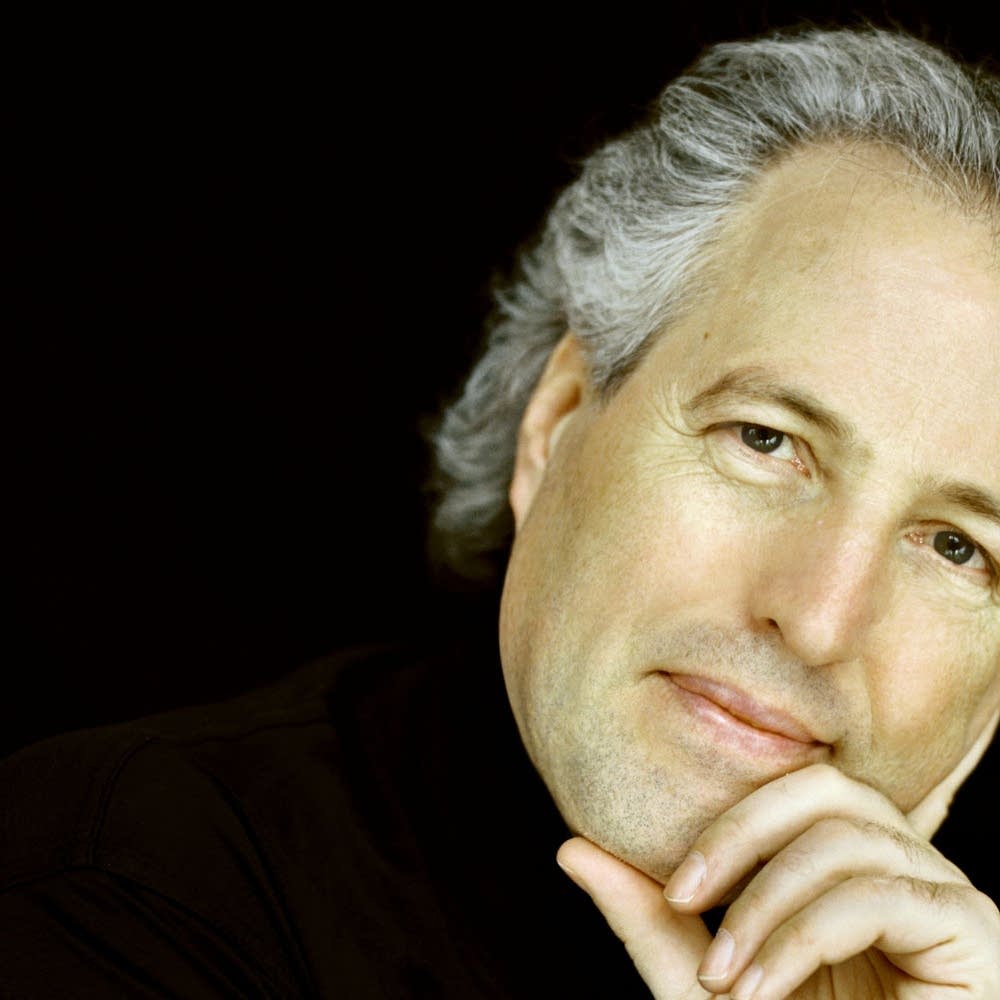
Alfred Brendel, the thoughtful Austrian pianist who focused on the classics, has died. A statement from his representative said that Brendel passed peacefully on Tuesday morning at his home in London, surrounded by his family. He was 94.
Praised by The Boston Globe as "one of the defining performers of our age," Brendel was best known as a performer who fused a keen intelligence with musical clarity. Other players were flashier; other players were, perhaps, more outwardly passionate. But Brendel had legions of ardent admirers.
Even Brendel himself confessed to documentary filmmaker Mark Kidel, who profiled him in 2000, that he found his success something of a mystery. "My career is atypical," Brendel said. "I have not been a child prodigy. My parents were not musicians — there was no music in the house. I have a good memory, but not a phenomenal one. I'm not a good sight reader. I'm completely at a loss to explain why I made it!"
Brendel was widely praised for his cerebral, lucid piano playing. But Tim Page, a Pulitzer Prize-winning music critic, says his playing wasn't for everyone's tastes.
"Some people found him dry," Page notes. "Some people found him perhaps a little bit over-scholastic. But there are others who really felt that this was a really first-class musical brain, working on some of the great music in the repertory."
Alfred Brendel was born in Wiesenberg, in what is now the Czech Republic, on Jan. 5, 1931. He had a peripatetic childhood, spending his early years in what was then Yugoslavia as well as Austria, as the family followed his father around to jobs as an architectural engineer, a businessman, a resort hotel manager and director of a local cinema.
While Brendel had some formal training — including a few years at the conservatory in Graz, Austria — he was largely self-taught. After an appearance in London in the 1970s, his international star began to rise.
Brendel was best known for his interpretations of the standard classical repertoire. Regarding Mozart, he said many players shied away from the composer — either because they didn't see his work's complexity and found it too easy, or did see the complexity and found it too difficult.
"When you play the sonatas," he told NPR in 2004, "you are all alone. And there are relatively few notes that you have to play. And every single one of these notes lays bare. It is a delicate balance between poise and seemingly casual delivery, which is necessary."
He was the first pianist to record the complete piano works of Beethoven, with three separate cycles of the 32 sonatas. "Because I am not one of the pianists who learns a piece, plays it and discards it," he told NPR, "I feel that one should keep in touch with those pieces which are really worth playing and live with them through a lifetime."
Brendel also wrote volumes of poetry and essays on music. He was known for his wit — a lecture he gave at Cambridge, England, in 1984 was titled "Does Classical Music Have to Be Entirely Serious?" — which extended to a fondness for Dadaist art and a collection of kitsch objects.
Just weeks before his 78th birthday, Brendel retired from public performance, giving his last concert at the gilded Musikverein in Vienna, playing a youthful yet enigmatic piano concerto by Mozart and a solo piece by Liszt, another of his favorite composers. Still, he remained busy, writing, painting and lecturing for years to come.
Copyright 2025, NPR
Love the music?
Show your support by making a gift to YourClassical.
Each day, we’re here for you with thoughtful streams that set the tone for your day – not to mention the stories and programs that inspire you to new discovery and help you explore the music you love.
YourClassical is available for free, because we are listener-supported public media. Take a moment to make your gift today.